Introduction: Who Is Makima in Chainsaw Man?
If you have been watching anime lately, one name keeps coming up in every discussion forum, fan art page, and “best villain” ranking — Makima Chainsaw Man. She is not the loudest character in the room. She does not scream her evil plans. Instead, she walks in quietly, smiles, and dismantles your entire world before you even realize what happened.
Makima is the central antagonist of the first arc of Chainsaw Man, the manga written and illustrated by Tatsuki Fujimoto. She serves as a high-ranking Public Safety Devil Hunter in Japan, appearing early in the story as a figure of authority and — at first glance — a possible mentor or love interest for the protagonist, Denji. But Makima Chainsaw Man is nothing close to what she seems. She is the Control Devil, a being feared even among other devils, and her manipulation runs deeper than anyone in the story anticipates.
This article covers everything you need to know about Makima — her powers, her psychology, her most unforgettable scenes, and why the anime community cannot stop talking about her. Whether you just finished the first season of the anime or you have read the entire manga, this is your complete guide.
Makima’s Appearance and First Impressions
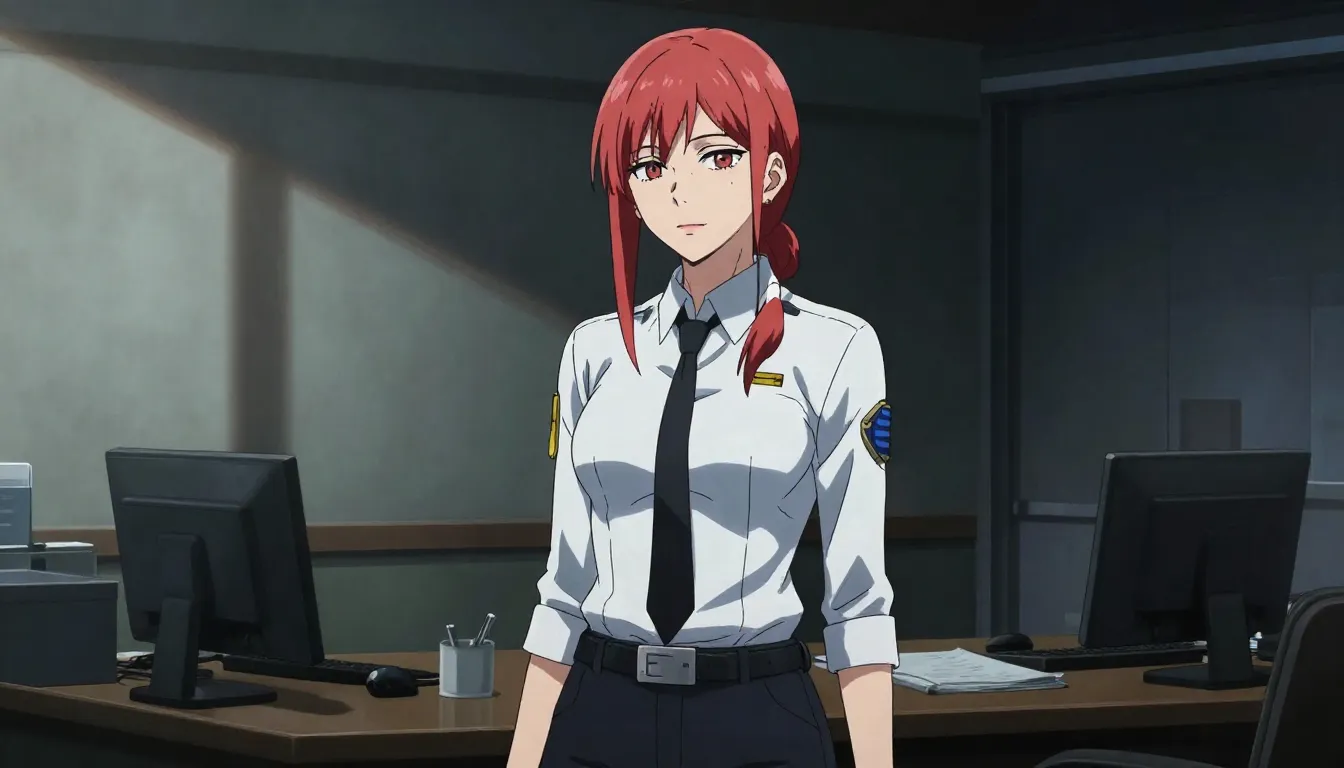
Makima Chainsaw Man presents herself with an almost disarming elegance. She has long auburn hair, pale skin, and eyes with ringed pupils that hint at her supernatural nature. She usually wears a formal suit in her role as a Public Safety officer, which reinforces her air of control and professionalism.
When you first see Makima, you get the feeling that she is competent and composed. She speaks softly. She never seems rattled. She holds eye contact in a way that feels both reassuring and deeply unsettling at the same time. That contrast is exactly what Fujimoto designed her to project.
Her physical appearance is deliberately approachable. This is part of the manipulation. Makima Chainsaw Man uses her calm, attractive exterior to lower the guards of everyone around her, especially Denji. She understands exactly how she is perceived, and she weaponizes it without hesitation.
Makima’s Personality: Calm on the Surface, Terrifying Underneath
You could describe Makima’s personality in three words: controlled, calculating, and cold. She never loses her composure. Even in situations of extreme violence or chaos, Makima remains eerily still. That stillness is part of what makes her so frightening.
She does not act out of passion or rage. Every single move Makima makes is calculated. She treats the people around her — including her subordinates and even Denji himself — as pieces on a chessboard. She does not see them as people. She sees them as tools.
Here is what makes Makima Chainsaw Man so psychologically fascinating:
- She genuinely believes she is doing something good for humanity
- She does not consider herself evil, which makes her far more dangerous than a villain who knows they are wrong
- She shows warmth and care selectively, precisely when it benefits her goals
- She uses love as a weapon, knowing that Denji’s attachment to her makes him easier to control
This is not a villain who twirls her mustache and laughs. Makima is a villain who feeds you carefully, keeps you close, and destroys you slowly with a smile on her face. That is what makes her feel real in a way that most anime antagonists do not.
Makima’s Powers and Abilities Explained
Makima Chainsaw Man is one of the most powerful characters in the entire Chainsaw Man series. Her abilities as the Control Devil are terrifying in both their scope and their implications.
The Power of Control
Her primary ability is control — specifically, she can dominate and manipulate any being she considers inferior to herself. This includes humans, fiends, hybrids, and even other devils. Once someone falls under Makima’s control, they lose their autonomy completely. She does not need to fight in the traditional sense. She simply takes command.
Long-Range Attacks
Makima can channel attacks through a ritualistic method. She lines up humans in a row, covers one of their heads, and transmits devastating force over enormous distances. The target does not see it coming. There is no warning. It is one of the most shocking abilities in the series because of how clinical it looks.
Near Immortality
Makima Chainsaw Man cannot truly die as long as the Japanese government exists as a contractor. Any fatal damage she receives gets redistributed among the citizens of Japan as illness or misfortune. She has been shot, stabbed, and seemingly killed multiple times in the story, and she keeps walking back in perfectly fine.
Sensory Network
She can see and hear through rats, birds, and other animals. This gives her a surveillance network that covers vast areas. No one around her can truly have a private conversation or movement she is not aware of.
These abilities combined make Makima one of the most oppressive presences in modern manga. Fighting her feels pointless. Hiding from her feels impossible. That hopelessness is entirely intentional.
Makima’s True Identity: The Control Devil
The biggest reveal in the first arc of Chainsaw Man is that Makima is not just a powerful human hunter. She is a devil herself — specifically, the Control Devil, a being that embodies the fear of being controlled or dominated.
This reveal recontextualizes everything you thought you understood about her. Every act of kindness, every small gesture of warmth, every moment where you thought she might actually care about Denji — all of it was strategic. Makima Chainsaw Man viewed Denji as a pet. She said as much herself. She never saw him as a person deserving of genuine connection.
The Control Devil’s very nature means she is driven by an obsessive need to dominate everything around her. She wants to reshape the world using the power of Chainsaw Man — Denji’s devil form — to erase humanity’s most painful memories, specifically the fear of death, nuclear weapons, and other horrors. Her goal is utopian in her own mind. In reality, it is totalitarian control on a cosmic scale.
What is brilliant about Makima as a character is that Fujimoto never lets you forget that she is a devil. She does not pretend to have human feelings. She simply mimics them well enough to be convincing. That is the most disturbing thing about Makima Chainsaw Man.
Makima’s Relationship with Denji
The relationship between Makima and Denji sits at the emotional core of the entire first arc. You need to understand this dynamic to truly understand why Makima works so well as a villain.
Denji is a young man who has never known love, warmth, or basic human decency. When Makima appears and offers him food, shelter, and the faintest hint of affection, he attaches to her completely. He would do anything for her. He says so openly. And Makima uses that attachment mercilessly.
She gives Denji just enough hope to keep him compliant. She rewards him with small moments of acknowledgment. She dangles the possibility of something romantic — knowing full well she feels nothing for him beyond his usefulness. Makima Chainsaw Man is essentially running a long con on a traumatized teenager, and it is devastating to watch unfold.
What makes this relationship land emotionally is that Denji is completely aware on some level that something is wrong. But he chooses to believe anyway because the alternative — accepting that no one truly cares about him — is too painful. Fujimoto does not judge Denji for this. He asks you to understand it.
Makima’s Most Shocking Moments in the Series
Makima Chainsaw Man delivers some of the most jaw-dropping scenes in modern manga. Here are the moments that left readers completely stunned:
- The long-range assassination — Makima uses her ritual killing technique to eliminate a target from an impossible distance. The sheer coldness of the execution shocked readers deeply.
- Killing the Special Division team — In one of the manga’s most brutal sequences, Makima orchestrates the deaths of nearly every major character Denji had grown close to. She does it methodically and without remorse.
- The reveal of her true nature — When Makima finally drops the mask and explains what she truly is and what she truly wanted, the entire story reframes itself in an instant.
- Her battle with Chainsaw Man — The confrontation between Makima and Denji’s devil form is visually spectacular and narratively devastating. She treats it almost like a fan meeting her favorite idol.
- Her defeat — The way Denji ultimately defeats Makima Chainsaw Man is both heartbreaking and deeply clever. It subverts every expectation you might have had about how the fight would end.
Why Makima Is One of Anime’s Greatest Villains
The anime community has a long history of iconic villains. Light Yagami, Frieza, Pain, Dio Brando — the list goes on. Makima Chainsaw Man belongs in that conversation, and here is why she stands apart:
She is never cartoonishly evil. She has a coherent worldview. You can follow her logic even when you disagree with it completely. That clarity of motivation makes her feel real.
She reflects real human fears. The fear of being controlled — of losing your free will and autonomy to someone you trusted — is deeply relatable. Makima embodies that fear at its most refined.
She is written with extraordinary restraint. Fujimoto resists the temptation to over-explain her or make her monologue excessively. You learn about Makima mostly through what she does, not what she says. That restraint makes her far more unsettling.
She is genuinely sympathetic in a troubling way. This is the most impressive achievement. You understand Makima even as you watch her destroy people. You see the loneliness in her nature — a being incapable of genuine connection, only control. That tragedy does not excuse her, but it adds a layer of humanity that most villains never achieve.
Makima Chainsaw Man is the rare villain who makes you feel afraid, sad, and fascinated all at once.
Makima vs. Nayuta: What Changes After the Finale?
After Makima is defeated, the Control Devil reincarnates in a new form — a young girl named Nayuta. Denji takes on the responsibility of raising her. This is a deeply intentional narrative choice by Fujimoto.
Nayuta has the same fundamental nature as Makima Chainsaw Man. She is still the Control Devil. She still has enormous power. But she grows up in an environment of genuine care rather than cold calculation. The question the story raises is whether the same nature, raised with real love, becomes something different.
Where Makima was the product of a world that treated power as something to be wielded over others, Nayuta represents the possibility of change. She is Makima given a second chance — not to redo her mission, but to simply exist as something other than a weapon or a master.
This contrast is one of the most thematically rich elements of Chainsaw Man, and it adds enormous retrospective depth to everything Makima did in Part 1.
What Fans Say About Makima Chainsaw Man
The fan response to Makima Chainsaw Man has been extraordinary. She consistently ranks among the top characters in annual anime polls. Her fanbase is enormous, spanning from people who find her genuinely terrifying to people who describe her as their favorite character precisely because of her complexity.
Fan artists produce incredible amounts of content featuring Makima. Cosplayers recreate her signature look at conventions worldwide. Discussions about her motivations, her psychology, and her relationship with Denji fill forums and YouTube comment sections years after the manga arc concluded.
One interesting thing about the Makima fandom is how divided it is. Some fans sympathize with her deeply and focus on the loneliness at the core of the Control Devil’s existence. Others see her as a straightforward monster and love her for exactly that reason. Both readings are valid, which tells you everything about how well written she is.
Conclusion
Makima Chainsaw Man is a masterclass in villain writing. She is terrifying without being theatrical. She is sympathetic without ever being excused. She manipulates, controls, and destroys — and she does it all with the calm certainty of someone who has never doubted herself for a single moment.
Tatsuki Fujimoto created in Makima a character who feels genuinely dangerous on a psychological level. She does not just threaten physical harm. She threatens the idea of trust itself. After watching or reading her arc, you understand Denji’s experience in your bones — the desperate need to believe that someone cares, and the quiet horror of discovering you were wrong.
If you have not read the Chainsaw Man manga beyond what the first anime season covers, the Makima arc alone is worth your time. And if you have already read it — you already know why this character is unforgettable.
Who is your favorite villain in anime, and how do you think Makima Chainsaw Man compares? Drop your thoughts and let the debate begin.
FAQs About Makima Chainsaw Man
1. Who is Makima in Chainsaw Man? Makima is the main antagonist of the first arc of Chainsaw Man. She works as a high-ranking Public Safety Devil Hunter but is secretly the Control Devil, a powerful devil who embodies the concept of domination.
2. Is Makima Chainsaw Man a villain or an anti-hero? Makima is a villain. While she believes she is working toward a better world, her methods involve manipulation, mind control, and the deaths of many people, including Denji’s closest companions. There is no anti-hero framing that holds up once her true nature is revealed.
3. What are Makima’s powers in Chainsaw Man? Makima can control humans and devils she considers inferior, perform long-range ritualistic attacks, redistribute fatal damage to Japanese citizens, and surveil large areas through animals. Her power set makes her nearly impossible to fight directly.
4. How does Makima die in Chainsaw Man? Denji defeats Makima by dismembering her body and consuming her flesh over several days, becoming a part of each other in a literal sense. This method prevents the Control Devil from identifying him as a threat and redistributing the damage to others.
5. Why did Makima treat Denji like a pet? Makima is the Control Devil. She is incapable of seeing others as equals. She can only see beings as things to control or as threats. Denji, as Chainsaw Man’s host, was uniquely valuable to her goals, so she kept him close through emotional manipulation rather than direct domination.
6. Is Makima in love with Chainsaw Man? Makima is obsessed with Chainsaw Man as a concept and as a power, not with Denji as a person. She admires the Chainsaw Devil’s ability to erase devils from existence and history. What she feels is closer to obsession than love.
7. What is the difference between Makima and Nayuta? Both are incarnations of the Control Devil. Makima grew up within a system that shaped her into a weapon of control. Nayuta is being raised by Denji with genuine care, representing the possibility that the same nature can develop differently under different conditions.
8. Why is Makima so popular with fans? Makima Chainsaw Man resonates because she is written with real psychological depth. She is frightening, tragic, and fascinating in equal measure. Her design is iconic, her power is overwhelming, and her arc contains some of the most emotionally affecting moments in modern manga.
9. Does Makima appear in Chainsaw Man Part 2? Makima herself does not appear in Part 2, but Nayuta, her reincarnation, is a recurring presence. Nayuta shares Makima’s appearance and abilities but is growing up in a very different environment under Denji’s care.
10. What does Makima represent thematically in Chainsaw Man? Makima represents the fear of control and the danger of conditional love. She also serves as a critique of authority and blind devotion. The story uses her to ask whether a person — or a devil — shaped entirely by power can ever experience genuine connection.
About the Author
Johan Harwen Kei is an anime writer and pop culture analyst with over seven years of experience covering manga, shonen series, and character-driven storytelling. Johan Harwen has contributed to multiple online publications focused on Japanese entertainment and writes weekly breakdowns of ongoing anime arcs. When not rewatching Chainsaw Man for the fifth time, Jordan is hiking or deep in a new fantasy novel.
Also read asukaevangelion.com
Email: johanharwen314@gmail.com
Author Name: Johan Harwen