
Introduction
If you have ever held an old Evangelion figure and wondered whether it is worth something serious, you already understand the pull of this hobby. Neon Genesis Evangelion has one of the most passionate collector communities in the world, and the market for rare Evangelion collectibles is bigger than ever in 2024.
Knowing how to identify rare Evangelion collectibles can mean the difference between paying $30 for a treasure and $300 for a cheap replica. This guide walks you through every major signal: packaging details, manufacturer marks, production years, material quality, and secondary market data. Whether you collect figures, prints, vintage merchandise, or limited-edition releases, this article covers what you need.
You will learn how to spot authentic pieces, understand rarity tiers, and evaluate condition like a professional. Let’s get into it.
Why Identifying Rare Evangelion Collectibles Matters More Than Ever
The Evangelion franchise celebrated its 30th anniversary in 2025. That milestone pushed collector demand to a new peak. Auction prices for rare Evangelion collectibles on Yahoo Japan Auctions and eBay have climbed 40 to 60 percent compared to five years ago, according to collector community data from EvaGeeks Forum and Reddit’s r/evangelion.
When a single authentic GAINAX-era Rei Ayanami garage kit can sell for over $1,000, the stakes are real. Counterfeits have flooded the market, and even experienced collectors get burned. Building a reliable eye for authenticity protects your investment and helps you build a collection you are genuinely proud of.
The Foundation: Understanding Evangelion Collectible Categories
Before you learn how to identify rare Evangelion collectibles, you need to know the categories. Each type has its own rarity signals.
Scale Figures
Scale figures represent the largest and most valuable segment. The most sought-after pieces come from:
- GAINAX Official Goods (1995 to 2007): Early GAINAX-licensed figures carry the highest premium for vintage authenticity.
- kotobukiya, Kaiyodo, and Max Factory: These manufacturers produced limited print runs throughout the late 1990s and 2000s.
- Rebuild of Evangelion exclusives (2007 onward): Limited Wonfest and Wonder Festival figures are extremely difficult to find.
Garage Kits (GKs)
Garage kits are resin models, originally sold at Wonder Festival under the “Wonder Showcase” system. These require assembly and painting. Authentic Wonder Festival garage kits always come with an event-specific sales slip or certificate inside the box. If that slip is missing, treat the piece with skepticism.
Vintage Merchandise (1995 to 1998)
This era produced the rarest Evangelion collectibles. Items include cel-style vinyl figures, original TV broadcast promotional materials, and limited-edition packaging from the original Gainax store. Condition matters enormously here. A sealed vintage item can be worth ten times the price of the same item opened.
Print and Paper Goods
Original theatrical program booklets, production cels, and event-exclusive poster prints fall into this category. These are among the hardest items to authenticate because reproduction is easy.
How to Identify Rare Evangelion Collectibles: The 7 Core Checks
Here is a practical framework. Apply all seven checks before you make any purchase decision.
1. Verify the Manufacturer Mark and License Text
Every legitimate rare Evangelion collectible carries a licensing stamp. Look for the text “© GAINAX” or “© khara” depending on the production era. After 2007, khara took over the IP, so older GAINAX marks on newer boxes are an immediate red flag.
The stamp is usually on the bottom of a figure’s base, on the inside of a box flap, or on the back panel of a print. If the stamp is missing, blurry, or uses non-Japanese character encoding that looks off, walk away.
2. Examine the Box Construction and Print Quality
Official rare Evangelion collectibles use high-density cardboard for boxes. The print resolution on authentic boxes is sharp and consistent. Look for these details:
- Pantone-accurate colors: Unit 01’s purple is a very specific shade. Bootlegs often look slightly green-purple or lavender instead.
- Clean foil stamping or embossing on premium releases.
- Precise box joints with no gaps or rough edges.
- Japanese language text that reads naturally, not machine-translated.
Bootleg boxes often have smeared registration marks where the colors do not line up perfectly. Hold the box under bright light and check the corners of text blocks.
3. Check the Production Run Number and Event Certificate
Limited-run rare Evangelion collectibles often include a production number. This appears as a stamped or printed sequence like “0342/1500” on the base of a figure or inside a box lid. Verify this number against known production databases.
The Wonder Festival Garage Kit database maintained at GarageKit.net tracks many legitimate event-exclusive releases. If the item you are looking at claims to be a Wonder Festival exclusive but does not appear in the database, request full provenance documentation from the seller.
4. Assess Material Quality
Authentic rare Evangelion collectibles use materials that feel premium in your hand. Here is what to look and feel for:
For scale figures:
- PVC should feel slightly flexible but firm. Brittle or waxy PVC is a counterfeit signal.
- Paint should have no brush marks and clean edge lines between colors.
- Eye decals on authentic figures from manufacturers like Max Factory and Good Smile Company (which now handles many Eva licenses) are perfectly centered and have a subtle gloss finish.
For resin garage kits:
- Authentic resin feels dense and slightly cool. Cheap knockoffs use a lighter, more hollow-feeling resin.
- Seam lines on legitimate kits are cleanly pulled. Bootleg recasts often have visible pour channels and rougher surface texture.
For paper goods:
- Original production cels use cel paint on acetate sheets. The paint has a specific matte finish on one side and a slight sheen on the other.
- Reproduction prints on modern paper feel too uniform and lack the slight age patina of genuine vintage pieces.
5. Research the Release History
This step separates casual collectors from experts. Every major rare Evangelion collectible has a release history. Before buying, spend twenty minutes researching:
- When was this item reportedly released?
- Which retailer or event distributed it?
- What was the original retail price in yen?
- Are there documented photos of authentic examples on platforms like Myfigurecollection.net?
Myfigurecollection.net (MFC) is the most comprehensive public database for scale figures. If a figure claiming to be rare Evangelion merchandise does not appear on MFC, that is a significant warning sign.
6. Cross-Reference Pricing Against Known Sold Listings
Rarity is defined partly by price. If someone offers you a “rare” piece at a suspiciously low price, that is not luck. It is almost always a fake or a heavily damaged item.
Use these platforms to check real sold prices:
- Yahoo Japan Auctions via Buyee or Zenmarket: The most accurate global price signal for Japanese collectibles.
- eBay sold listings: Filter by “Sold Items” for actual transaction data, not asking prices.
- Mandarake online shop: Mandarake is a professional Japanese reseller with strict authentication. Their prices are a reliable ceiling for legitimate items.
7. Assess the Seller’s Provenance Documentation
For high-value rare Evangelion collectibles, always ask for provenance. A legitimate seller can provide:
- Original purchase receipts from Japanese retailers such as Animate, Mandarake, or Surugaya.
- Event documentation for Wonder Festival or Wonfest exclusives.
- Photographs of the item in original packaging before shipping.
A seller who refuses to provide any documentation for a $400 figure is a red flag. Reputable sellers expect these questions and welcome them.
The Rarest Evangelion Collectibles and What Makes Them Valuable
Understanding which items sit at the top of the rarity pyramid helps you prioritize your checklist.
GAINAX Original Store Exclusives (1997 to 2001)
The GAINAX Official Shop, which operated from a small space in Koenji, Tokyo, sold a small number of exclusive figures and goods that never reached wider distribution. These items had production runs as low as 50 to 100 units. Identifying them requires documentation because they often lacked standard retail packaging.
Evangelion Store Lucky Pack Contents
EVANGELION STORE’s annual Lucky Pack (fukubukuro) has included exclusive items since 2011. Some figures released only through these Lucky Packs now trade for three to five times their original lucky pack value. Check the item’s base for the EVANGELION STORE copyright and a Lucky Pack series code.
Wonder Festival Limited Garage Kits by Licensed Sculptors
Kits by notable sculptors such as Kotsu (known for hyper-detailed Eva figure work) carry collector premiums independent of the franchise alone. A rare Evangelion collectible by a well-known sculptor at Wonder Festival 2004 or 2006 can command $500 to $2,000 on today’s market.
Original Production Cels from the TV Series
GAINAX sold original production cels through their store and at events in 1996 and 1997. These are the highest-value paper collectibles. Each cel should come with a background reference sheet, and authentic ones have specific registration cross marks in the corners printed on the acetate. Reproductions lack these marks or place them incorrectly.
Common Mistakes Collectors Make When Identifying Rare Evangelion Collectibles
Even experienced collectors make these errors. Knowing the pitfalls keeps your collection clean.
Trusting listing photos alone. Photos can be lifted from legitimate sources and used to sell fakes. Always request additional angles, especially of the base stamp and box interior.
Ignoring box condition for vintage items. A mint-in-box rare Evangelion collectible is worth significantly more than the same item loose. Many sellers separate items from boxes and sell them individually, destroying provenance in the process.
Confusing official re-releases with originals. Several classic Evangelion figures have been re-released as anniversary editions. These are legitimate products but not original runs. They carry different value. Always check the copyright year on the base and compare it to production records.
Overlooking regional variants. Some rare Evangelion collectibles were released in different colorways for different markets. The Japanese domestic version is almost always more valuable than the international export version of the same item.
Building Your Authentication Toolkit
You do not need expensive equipment to identify rare Evangelion collectibles reliably. Here is what I recommend keeping handy:
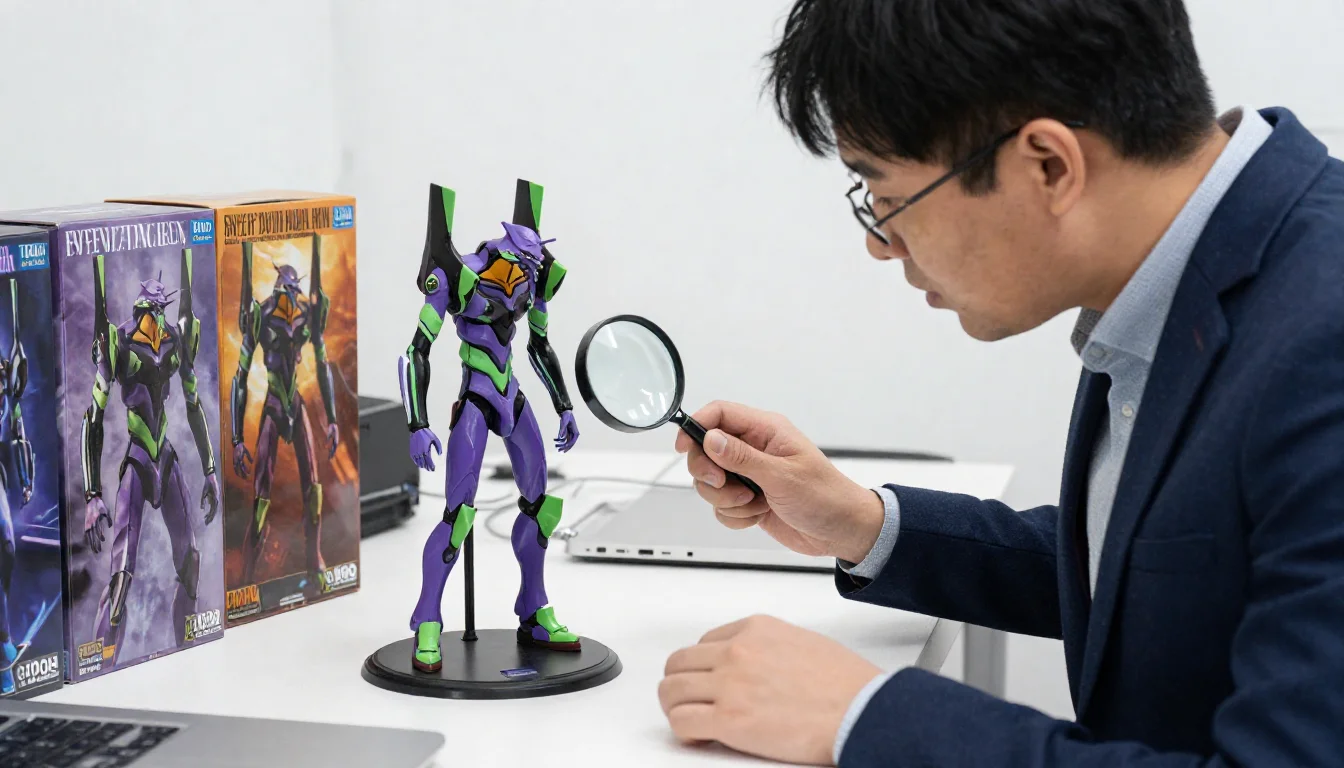
- A 10x loupe magnifier for examining print quality and stamp marks.
- A small UV flashlight for detecting modern resin recasts (new resin glows under UV differently than aged original resin).
- A smartphone with the Buyee or Zenmarket apps installed for real-time price checking.
- A bookmark folder with MFC, the GarageKit.net database, and at least one active Eva collector community like EvaGeeks Forum.
Where to Buy Rare Evangelion Collectibles Safely
Knowing where to shop reduces your risk significantly.
Mandarake: The gold standard for secondhand Japanese collectibles. Staff are trained to authenticate items.
Surugaya: Another professional Japanese reseller with good authentication practices.
EVANGELION STORE official site: For new official releases, buying directly eliminates fakes entirely.
Reputable international dealers: Shops like AmiAmi and HobbySearch sell new stock from licensed manufacturers. These are never counterfeit.
Avoid buying high-value rare Evangelion collectibles from unverified social media sellers or marketplace platforms without seller ratings and return policies.
Conclusion
Learning how to identify rare Evangelion collectibles takes time, but the framework is clear. Check the manufacturer mark, examine packaging quality, verify production numbers, assess material quality, and always cross-reference pricing and provenance before committing to a purchase.
The Evangelion collectibles market rewards patient, informed collectors. The more you handle authentic pieces and compare them against documented examples, the faster your eye develops. Start with lower-priced items to build your knowledge base before moving into high-value territory.
Have you found a rare Evangelion collectible you were not sure about? Drop your experience in the comments below or share this guide with a fellow collector who could use it.
Frequently Asked Questions
How do I know if my Evangelion figure is valuable? Check the manufacturer, production year, and run number against databases like Myfigurecollection.net and sold listings on Yahoo Japan Auctions. Figures from limited events or early GAINAX-era releases tend to carry the highest value.
What is the rarest Evangelion figure? GAINAX Official Shop exclusives from 1997 to 2001 and certain Wonder Festival garage kits by notable sculptors are among the rarest. Original production cels from the TV series are also exceptionally rare.
How can I tell if an Evangelion garage kit is a bootleg recast? Recasts feel lighter and have rougher surface texture. Authentic Wonder Festival kits include an event sales slip inside the box. Check the GarageKit.net database to verify the kit’s legitimate release history.
Where is the best place to buy authentic rare Evangelion collectibles? Mandarake and Surugaya are the most trusted secondhand Japanese retailers. For new stock, AmiAmi and the EVANGELION STORE official site are the safest options.
What does the copyright mark on an Evangelion figure tell me? Items produced before 2007 should read “© GAINAX.” Items from 2007 onward should read “© khara.” A post-2007 figure with only a GAINAX mark (without khara) is a red flag worth investigating further.
Are re-release Evangelion figures worth collecting? Official re-releases are legitimate products but carry less collector value than original run items. They are a good entry point for building your display collection without paying original-run premiums.
How important is the box for value? For vintage items, the original box is extremely important. A sealed box can multiply value by three to ten times compared to a loose piece. Never discard original packaging from a potentially valuable item.
What is a production cel and how do I authenticate one? A production cel is an original hand-painted animation frame used during production. Authentic cels have acetate sheets with cel paint, registration cross marks, and often a background reference sheet. Reproductions lack proper registration marks and use modern print techniques.
What tools do I need to authenticate Evangelion collectibles at home? A 10x loupe, a UV flashlight, a smartphone with price-checking apps, and bookmarked access to MFC, GarageKit.net, and collector communities are the essentials.
Can I get an Evangelion collectible professionally appraised? Yes. Some Japanese auction houses offer appraisal services. Active members of the EvaGeeks collector community and verified sellers on Mandarake can also provide expert informal opinions.
Author Bio
Johan Harwen is a certified anime merchandise specialist and collectibles writer with over ten years of experience in the Japanese figure market. He has contributed authentication guides to several collector communities and has personally evaluated thousands of scale figures, garage kits, and vintage anime goods. He specializes in GAINAX-era collectibles and runs an independent authentication consulting service for serious collectors.
Also read asukaevangelion.com
Email: johanharwen314@gmail.com
Author Name: Johan Harwen