
Introduction: The Man Behind the Greatest Deception in History
You have probably heard of the Trojan Horse. But do you know the name of the man who made it work? That man was Sinon.
In Greek mythology, Sinon was a Greek soldier and cunning spy who played a decisive role in the fall of Troy. He was not a mighty warrior like Achilles, and he did not command fleets like Agamemnon. His weapon was something far more dangerous: words. Through deliberate deception and a brilliantly crafted false story, Sinon convinced the Trojans to drag a giant wooden horse inside their city walls, unknowingly sealing their own doom.
Sinon Greek mythology represents one of the most calculated acts of deception in all ancient literature. Without him, the Trojan Horse would have stayed outside the walls of Troy. Without him, the Greeks might never have won the war at all.
This article covers everything you need to know about Sinon: who he was, what he did, why he did it, how ancient writers portrayed him, and what happened to him after Troy burned.
Who Was Sinon in Greek Mythology?
Sinon was a Greek soldier who served in the army that besieged Troy for ten years. Ancient sources give him a specific family connection that matters. He was a cousin of Odysseus, the craftiest Greek hero in the entire Trojan War cycle.
Some ancient traditions describe him as the son of Aesimus or the grandson of Autolycus, a legendary trickster figure. That lineage is important. Autolycus was famous in Greek mythology for cunning and theft. Sinon inherited those traits in full.
His name itself carries meaning. Some scholars connect “Sinon” to a Greek root meaning “to harm” or “to injure.” Whether that etymology is exact or not, his name fits his role perfectly. He was the man sent to harm Troy from the inside.
Sinon was not a mythological hero in the traditional sense. He did not fight monsters or complete heroic labors. He was a soldier chosen for one specific mission that required intelligence, nerve, and the ability to lie convincingly under extreme pressure.
What Did Sinon Do in the Trojan War?
Sinon’s role in the Trojan War is best described in Virgil’s Aeneid, though the story also appears in earlier Greek sources. Here is how his mission worked.
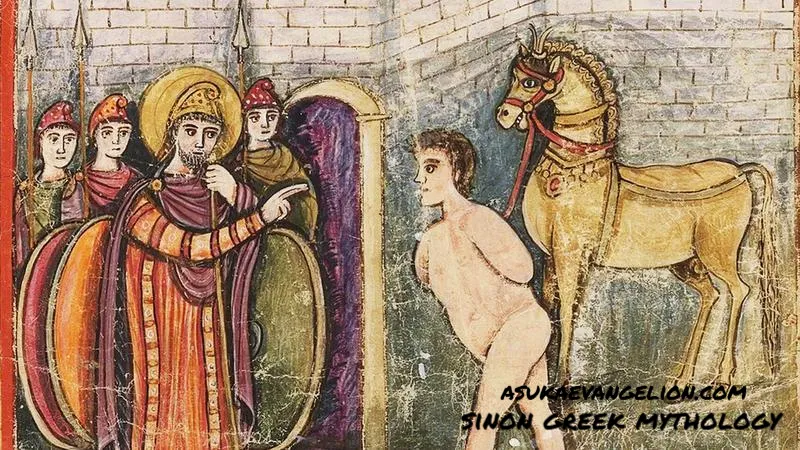
After ten years of war, the Greeks had a bold plan. They built an enormous wooden horse, filled it with elite soldiers, and pretended to sail away. They left Sinon behind, alone, near the Trojan shore. The plan required Sinon to be captured by the Trojans and then lie his way through interrogation.
When Trojans found him, they brought him before King Priam. Here is where Sinon’s genius showed itself. He told a story so detailed and so emotionally compelling that the Trojans believed every word of it.
His story went like this:
- He claimed the Greeks had grown desperate and needed divine favor to sail home safely.
- He said the prophet Calchas had demanded a human sacrifice to appease the gods.
- He told the Trojans that he, Sinon, had been chosen as that sacrifice because Odysseus hated him personally.
- He said he escaped before the Greeks could kill him and now had nowhere to go.
The Trojans felt sympathy for him. King Priam showed mercy and freed him from his bonds. Sinon then delivered the final piece of his deception.
He told the Trojans the wooden horse was a sacred offering to the goddess Athena. He said the Greeks had built it deliberately large so the Trojans could never bring it inside their city. If the Trojans destroyed it, Athena would punish them. If they brought it inside, Troy would become unconquerable forever.
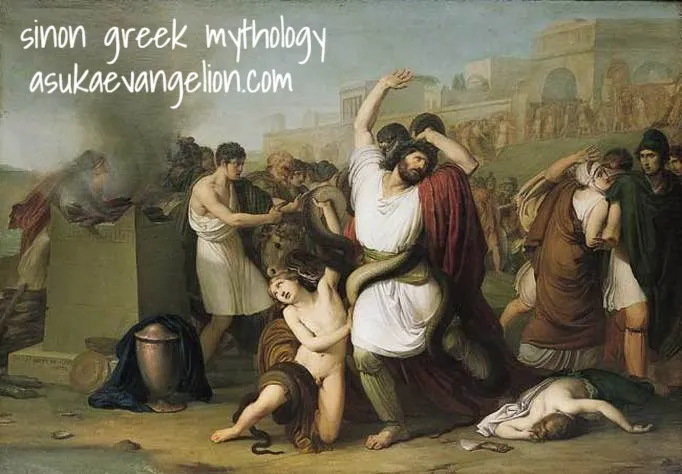
The Trojans debated. Some Trojans resisted. The priest Laocoon famously warned that the horse was dangerous. A sea serpent killed Laocoon and his sons, which the Trojans read as a divine sign that Sinon was telling the truth.
The Trojans made their fatal choice. They pulled the horse inside their walls.
That night, Sinon signaled the Greek fleet, which had hidden nearby. The soldiers inside the horse crept out, opened the city gates, and the Greek army poured in. Troy burned before dawn.
Why Did Sinon Agree to This Mission?
Sinon volunteered, or was chosen, for this mission because he had the right combination of qualities. He was intelligent, cool under pressure, and capable of holding a complex lie together while being interrogated by an enemy king.
His connection to Odysseus is key here. Odysseus was the architect of the Trojan Horse strategy. He needed someone who could sell the deception at ground level. Sinon was that person.
Ancient sources suggest that Sinon genuinely committed to the mission. He endured physical hardship, stayed behind enemy lines alone, and maintained his story through intense questioning. Whatever his personal motivations, he executed the plan flawlessly.
Sinon: Greek or Trojan?
Sinon was Greek. He was a soldier in the Greek army that besieged Troy. His mission required him to pretend he was a disgraced Greek who had been abandoned by his own people, but this was entirely fabricated. He remained loyal to Greece and to the mission throughout.
His deception was so convincing that some ancient readers and later interpreters occasionally confused his allegiance, but there is no ambiguity in the ancient sources. Sinon in Greek mythology is firmly a Greek soldier and spy.
Sinon’s Role in the Aeneid
Virgil’s Aeneid, written in the first century BCE, gives us the most detailed portrait of Sinon in all of ancient literature. Virgil presents Sinon in Book II through the eyes of Aeneas, who recounts the fall of Troy.
In Virgil’s version, Sinon is portrayed with a complex mix of admiration and horror. Aeneas remembers how persuasive Sinon was and how completely the Trojans fell for his story. Virgil writes Sinon as a master performer who weeps convincingly, plays the victim with precision, and never breaks character even when Trojans threaten him with violence.
Interestingly, Virgil presents the Trojans’ decision to trust Sinon as both understandable and tragic. They were not foolish people. They were deceived by an expert. That distinction matters in how we read the fall of Troy.
Later, the medieval poet Dante placed Sinon in the Inferno, in a circle reserved for those guilty of falsification and fraud. Dante’s Sinon argues even in hell, still trying to talk his way out of punishment. That detail shows how enduring Sinon’s reputation for clever argument became across centuries.
What Happened to Sinon After Troy Fell?
This is where the ancient sources become less clear, and you should know that different traditions give different answers.
Some ancient accounts suggest Sinon survived the sack of Troy and returned to Greece with the victorious army. Others do not mention his fate at all, which was not unusual for secondary characters in ancient epic cycles.
One tradition preserved in later sources claims Sinon was killed during or after the fall of Troy, possibly in the chaos of the battle. Another tradition in some ancient scholia suggests he lived and was honored for his role in the Greek victory.
The honest answer is this: we do not have a definitive account of Sinon’s fate after Troy fell. Ancient sources are silent or inconsistent on this point. What we do know is that his mission was the turning point of the entire war.
Sinon vs. Odysseus: A Brief Comparison
Both Sinon and Odysseus used cunning rather than brute force. But they operated differently.
| Sinon | Odysseus |
|---|---|
| Worked through direct deception and emotional manipulation | Used strategy, planning, and disguise |
| Operated alone behind enemy lines | Led teams and fleets |
| Played the victim to gain sympathy | Played many roles depending on the situation |
| Known primarily for one defining act | Known for a decade of clever exploits |
| Fate after Troy largely unknown | Spent ten years trying to get home |
Sinon was in many ways the perfect instrument for Odysseus’s plan. Where Odysseus was the architect, Sinon was the craftsman who built the deception in real time, under pressure, with no safety net.
Sinon Greek Mythology: Fast Facts
Here are the key facts you need to know about Sinon at a glance.
- Who he was: A Greek soldier and spy in the Trojan War
- Family: Cousin of Odysseus; possibly grandson of Autolycus
- His mission: Convince the Trojans to bring the Trojan Horse inside Troy’s walls
- His method: An elaborate false story about being a sacrificial victim abandoned by the Greeks
- Key moment: He signaled the Greek fleet after the Trojans brought the horse inside
- Main ancient source: Virgil’s Aeneid, Book II
- Later appearances: Dante’s Inferno, where he appears among fraudsters
- His legacy: The archetypal figure of strategic deception in Western literature
Why Sinon Still Matters Today
Sinon in Greek mythology is more than a footnote to the Trojan Horse story. He is the reason the story worked. Without a human being willing to stand alone, face interrogation, and sell an impossible lie with perfect conviction, the entire Greek strategy would have collapsed.
His story raises questions that feel just as relevant today. How do we recognize deception? What makes a lie believable? How does sympathy become a weapon?
The phrase “beware of Greeks bearing gifts” survives in modern language partly because of Sinon. His act of deception was so thorough and so devastating that it became a cultural warning passed down for thousands of years.
Conclusion
Sinon in Greek mythology is one of the most underappreciated figures in all of ancient storytelling. He was not the strongest Greek at Troy, nor the most famous. But he may have been the most effective. His single mission changed the outcome of a ten-year war.
If you find yourself fascinated by the psychological side of Greek mythology, Sinon is a character worth exploring deeply. He shows us that in the ancient world, as in ours, the mind can be a more powerful weapon than any sword.
Do you think Sinon deserves more recognition in Greek mythology discussions? Share your thoughts with someone who loves ancient history.
source: greekmythology.com
Frequently Asked Questions
Who was Sinon in Greek mythology? Sinon was a Greek soldier and spy who used deception to convince the Trojans to bring the Trojan Horse inside their city, leading directly to the fall of Troy.
Was Sinon related to Odysseus? Yes. Ancient sources describe Sinon as a cousin of Odysseus. Some traditions also connect him to Autolycus, a famous trickster figure in Greek mythology.
What lie did Sinon tell the Trojans? He told them he was a sacrificial victim who had escaped the Greeks, and that the wooden horse was a sacred offering to Athena that would protect Troy if brought inside the city walls.
Is Sinon mentioned in Homer? Sinon does not appear prominently in Homer’s Iliad or Odyssey. His most detailed portrayal comes from Virgil’s Aeneid, written centuries after Homer.
What is the Trojan Horse connection to Sinon? The Trojan Horse was built by the Greeks as a trick. Without Sinon’s persuasive deception, the Trojans would never have brought the horse inside the city. Sinon was the human element that made the strategy work.
Did Sinon survive the Trojan War? Ancient sources are unclear on his fate. Some traditions suggest he survived and returned to Greece. Others do not mention what happened to him after Troy fell.
Where does Sinon appear in later literature? Beyond Virgil’s Aeneid, Sinon appears in Dante’s Inferno in the circle of falsifiers, still arguing and deceiving even in the afterlife.
What does Sinon’s name mean? Some scholars connect the name Sinon to a Greek root meaning “to harm” or “to injure,” which fits his role as the instrument of Troy’s destruction.
How is Sinon different from Odysseus? Odysseus was the strategist who planned the Trojan Horse scheme. Sinon was the operative who executed the human deception part of the plan, working alone and under direct pressure from the enemy.
Why did the Trojans believe Sinon? Sinon’s story was emotionally compelling and internally consistent. He played the role of a wronged man with conviction. The death of Laocoon, which the Trojans interpreted as a divine sign, also reinforced their belief in Sinon’s words.
Author Bio: This article was written by a mythology and ancient history writer with a focus on classical Greek and Roman literature. With years of experience making ancient stories accessible to modern readers, the author specializes in turning complex mythological narratives into clear, engaging content for history enthusiasts and curious readers alike.
asukaevangelion.com
Email: johanharwen314@gmail.com
Author Name: Aria Nishimura